One day off won't break your habit
A habit is something you end up doing almost automatically, because a familiar situation sets it off. It forms gradually, and a single missed day doesn't take it back to zero. That is why, in Love Yourself, one day off a week doesn't break your streak.
How a habit forms
A habit grows out of repeating the same action in the same circumstances. Over time the time of day, the place or the previous activity prompts the next step by itself, so you no longer have to remember it (Wood and Neal, 2007).
In a study by Phillippa Lally and colleagues, 96 people spent 12 weeks doing a chosen eating, drinking or exercise behaviour every day, always in the same situation, such as after breakfast. Each day they rated how automatic it had become. Automaticity grew gradually. Among the participants whose results fitted the model, half reached a stable level within about 66 days, but the spread was wide: from 18 to 254 days. Times longer than the 12 weeks of the study are projections from the model (Lally et al., 2010).
Why a break doesn't wipe out progress
In the same study, missing a single opportunity did not materially affect how the habit formed (Lally et al., 2010). So after a break, simply coming back is enough.
Being kind to yourself helps too. Kristin Neff describes self-compassion as treating yourself with understanding in difficult moments rather than with harsh criticism (Neff, 2003). Instead of "I've failed again", it becomes easier to think: "yesterday was a break, today I'm back".
How to plan a rest day
- Choose it in advance, for example Sunday or a day when you are usually short of time.
- Keep the same time and place for the habit on the other days, so your surroundings keep prompting it.
- Keep the step small. In B. J. Fogg's model a behaviour happens when motivation, ability and a prompt come together at the same moment, such as a reminder at a time you choose (Fogg, 2009). A small step is easy, so it is more likely to happen.
- After a break, come back the next day without catching up. One entry is enough.
How the streak works in Love Yourself
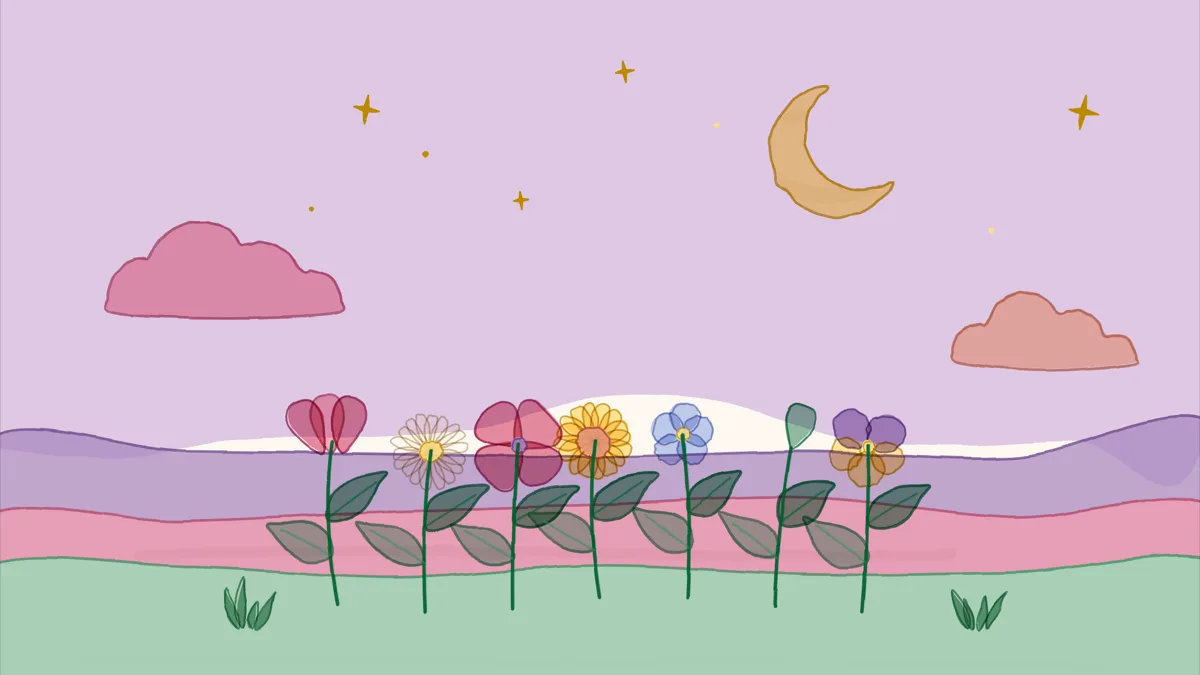
Your streak counts consecutive days with a reflection. In any seven consecutive days one entry can be missing and the streak carries on. In the flower atlas that day has its own flower, a closed one, with the note: "The flower rests along with you. Your streak carries on." A second day without an entry within seven days, including two days in a row, ends the streak, but the plants you have already collected in your Herbarium stay: a Sprout for 7 days, a Bud for 14 and a Tulip for 30.
Sources
- Fogg, B. J. (2009). A behavior model for persuasive design. Proceedings of the 4th International Conference on Persuasive Technology. doi.org/10.1145/1541948.1541999
- Lally, P., van Jaarsveld, C. H. M., Potts, H. W. W., Wardle, J. (2010). How are habits formed: Modelling habit formation in the real world. European Journal of Social Psychology, 40, 998–1009. doi.org/10.1002/ejsp.674
- Neff, K. D. (2003). Self-compassion: An alternative conceptualization of a healthy attitude toward oneself. Self and Identity, 2, 85–101. doi.org/10.1080/15298860309032
- Wood, W., Neal, D. T. (2007). A new look at habits and the habit–goal interface. Psychological Review, 114, 843–863. doi.org/10.1037/0033-295X.114.4.843
Love Yourself supports well-being and self-reflection. It is not a medical device and does not diagnose, treat, cure or prevent any condition. If you are struggling, please reach out to a professional. In an emergency, contact your local emergency number.